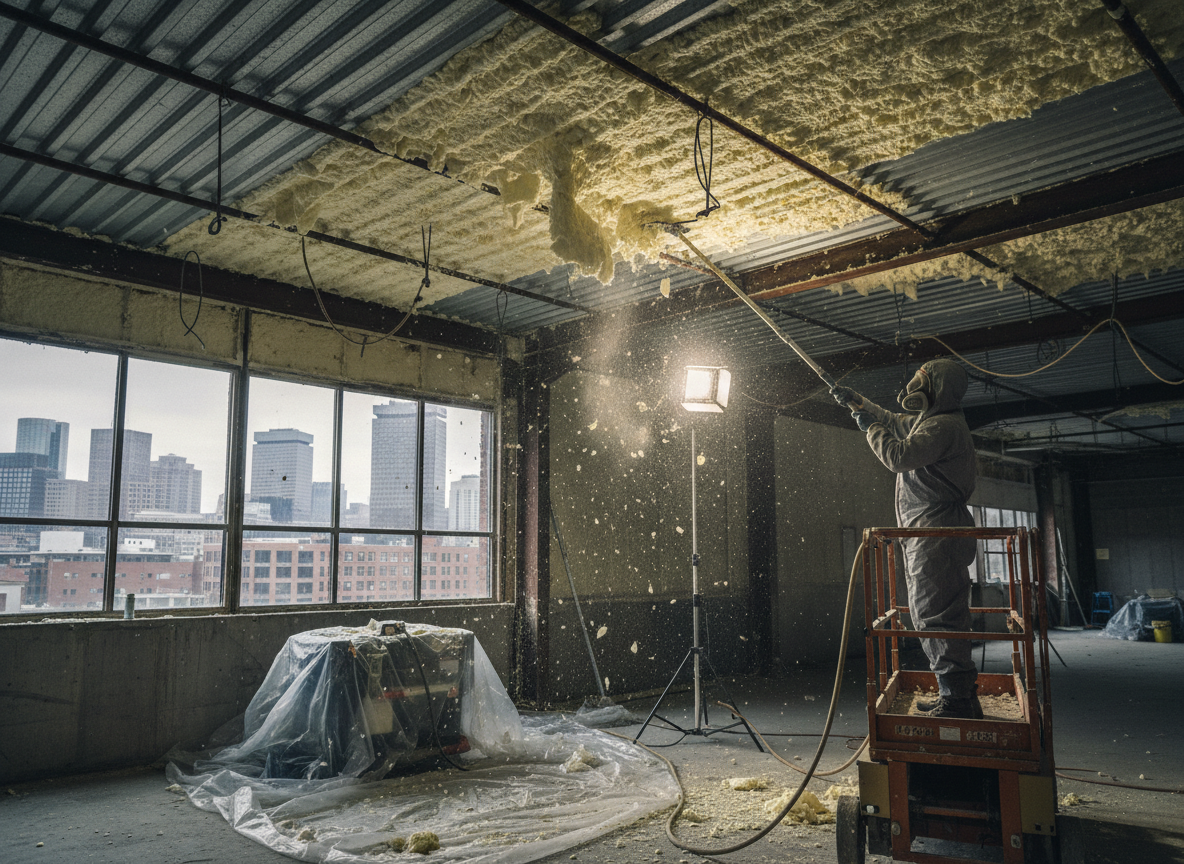
Commercial buildings in Boston often feature older brick and timber construction typical of Lincolnshire market towns, where spray foam was applied decades ago to warehouse ceilings and retail units. Removing it demands attention to load-bearing timbers and hidden voids around Strait Bargate and Wide Bargate, where moisture from the nearby River Witham can have caused the foam to bond tightly to substrates. Technicians must work around ongoing business operations, using containment barriers to limit dust spread into active trading spaces while preserving original masonry that may date back to the Victorian era.
Edge cases frequently arise in converted commercial spaces near the market square, where foam meets electrical conduits or ventilation ducts installed without modern fire separation standards. In these situations, removal crews isolate sections methodically to prevent damage to wiring or ductwork that could halt operations for days. Lincolnshire's frequent damp weather accelerates foam breakdown, releasing particles that require HEPA filtration during extraction to protect indoor air quality in occupied offices and shops.
Code considerations include checking that removal does not compromise existing fire compartmentation in multi-unit commercial blocks common along Bargate. Crews document substrate condition before and after work, noting any rot or corrosion revealed once foam is gone. This approach avoids callbacks when new insulation is later installed, especially in properties exposed to the county's cool, wet winters that drive condensation issues behind walls.
Technician insight
In Boston, the thing that catches most people out with Commercial Spray Foam Removal is how the damp Lincolnshire air around the River Witham has made foam bond hard to older brick in units near Strait Bargate, so crews need extra time and care to avoid pulling masonry loose during extraction.
Retail Unit Near Market Square
A Boston shop unit showed ceiling sagging after years of trapped moisture. Inspection found thick foam layers over original timbers. Removal proceeded section by section with full containment to keep the business open. Surfaces were left clean and dry for new ceiling work.
How it works
- 1
Site Assessment
Walk through the commercial property to map foam locations, note building age and access constraints around Boston streets, and identify any moisture or structural concerns.
- 2
Containment Setup
Install barriers and negative air machines to isolate the work zone, protecting adjacent retail or office areas from dust during removal.
- 3
Foam Extraction
Use mechanical and manual methods to strip foam from ceilings, walls and voids while monitoring for hidden services or fragile brickwork typical in Lincolnshire commercial stock.
- 4
Final Clearance
Remove all debris, vacuum surfaces, and conduct a walkthrough to confirm the space is ready for follow-on trades or reopening.
Pricing
Upfront quotes provided after site visit; cost depends on square footage, foam thickness and access difficulty in Boston commercial buildings.